The Square Was a Stockyard: A Trading History Walk Around Stow
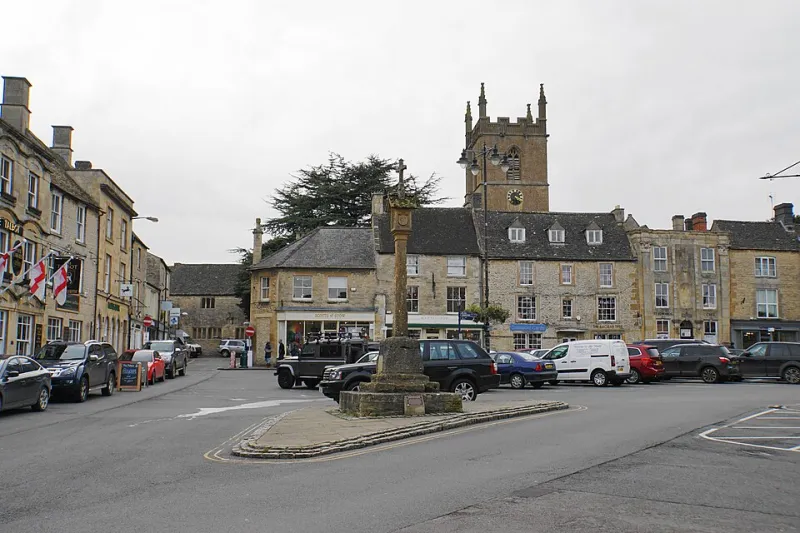
Photo: Bill Boaden , CC BY-SA 2.0, via Wikimedia Commons
Stow's square is the thing everyone photographs and almost nobody reads properly. Visitors see a wide, slightly sloping expanse of setts and assume it's just pretty. Locals know better. That width wasn't an accident of town planning — it was a stockyard, a trading floor and a car park for drovers, all at once. Spend half a day walking it slowly and you can still trace the bones of the old fairs underneath the coffee shops and the parked estates.
This isn't a museum walk. It's about 1.5 miles, two to three hours at a dawdle, and it starts and finishes within sight of the cross. Bring decent shoes — the setts are uneven and slick when wet — and keep a fiver for a coffee.
Start at the cross, not the shops
Stand on the pavement by the market cross and turn your back on the shop windows. That's the first rule. The cross you see today is a Victorian replacement sitting on a much older base, but the spot is the whole point: markets happened here, in the open, with the cross as the fixed marker everyone could find. Fairs were granted to Stow by charter in the medieval period, and by the time the wool trade was roaring, this hilltop was one of the busiest trading points in the north Cotswolds.
Look at the slope under your feet. The square falls away gently towards the church end and towards Sheep Street. That's not decorative either — it helped drain the square when it was full of animals. Livestock, mud and rain are a grim combination, and the town's builders knew it.
Why the square is quite so wide
Walk the perimeter once, slowly, and notice how the buildings don't so much face the square as contain it. There's a reason for that. The wide open space was needed for pens, for horses being trotted up and down, and for the sheer volume of people who arrived for the big fairs. Stow's October fair — known simply as Stow Fair — was famous across the country for horses as well as sheep, and the town swelled accordingly.
The odd thing is how little of that is explained on the ground. There's no grand interpretation board telling you where the pens went. You have to read it from the shape of the place: the wide mouth of the square, the narrow exits, the way the streets pinch as they leave. That pinch is deliberate. Funnel a flock through a narrow street and you can count it, tax it and keep an eye on it. Wide square, tight exits — that's a livestock town's anatomy.
Look down at the setts near the cross while you're at it. These are the same stones that took a hammering from hooves for centuries. It's a small thing, but once you've clocked it, the square stops being a backdrop and starts being a working space.
Sheep Street and the droves
Head down Sheep Street, which is about as subtle as street naming gets. This was the route the animals took in and out of the square, and the street still has that corridor feel — buildings tight on both sides, the road sloping away, no room for nonsense.
Halfway down, pause and look back uphill. You get the classic Stow view: the street rising to the square, the cross just visible, the town stacked up on its hill. Drovers would have seen this view with a few hundred sheep in front of them and a long day behind them. It's worth a moment.
Carry on and loop back via Digbeth Street, which was another trading artery. The name has old roots and the street has the same narrow, purposeful feel. If you're doing this with a dog, keep it close — these streets are busy with delivery vans and the pavements are narrow.
Yards, arches and the coaching trade
Not all of Stow's trading past was livestock. The coaching trade mattered just as much, and you can still see it in the yards behind the inns. Walk past The Porch House and The Talbot and look for the gaps — archways, passages and courtyard spaces that once swallowed coaches, horses and overnight guests.
These yards are the quietest bit of the walk, and the most overlooked. Most visitors walk past them without a second glance because there's no sign saying "historic coaching yard". There doesn't need to be. A gap wide enough for a coach, a courtyard behind it, a pub at the front — that's the pattern, and once you know it you'll spot it all over town.
Where to pause
You've earned something by this point. Two good options, depending on the hour.
For coffee and a sit-down, head back to the square and pick somewhere with a window seat facing the cross. There's a certain pleasure in drinking a flat white on the exact spot where a sheep fair used to happen. If it's too nice to be indoors, take it out and lean on the railings.
For a pint, The Kings Arms or The Sheep on Sheep Street both make sense — the latter particularly, given you've just walked the street it's named after. The Talbot works well too if you've been peering into its yard and want to see the inside. All three are proper pubs rather than themed attractions, which is the correct spirit for this walk.
The practical bits
- Distance: roughly 1.5 miles, mostly flat but with a slope in the square and uneven setts throughout.
- Time: two to three hours including pauses. You could do it in 45 minutes if you marched, but you'd miss the point.
- Start/finish: the market cross, Stow-on-the-Wold square.
- Parking: use the long-stay car park off Sheep Street rather than trying to bag a square-side space. Weekends in 2026 are busy and the square fills early.
- Best time: early morning before the coaches arrive, or late afternoon when the light hits the cross and the square empties out.
- Watch out for: the setts after rain. Genuinely slippery in places, especially on the slope.
One last look
Before you leave, stand at the top of the square near the town hall and look back down the whole space. Wide, sloping, ringed by buildings, exits pinching away at the corners. That's not a postcard — that's a working stockyard that got dressed up in Cotswold stone and turned into a coffee stop. Once you've seen it that way, you can't unsee it, and every visit to the square afterwards feels a bit like walking across a very well-preserved piece of paperwork.