The Wall Watcher's Amble: How to Read Stow's Stonework
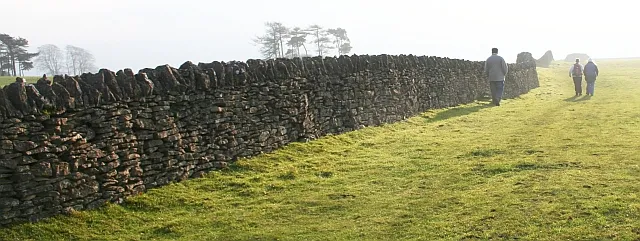
Photo: Bob Embleton, CC BY-SA 2.0, via Wikimedia Commons
Stow is often summed up in one word: honey. It is a good word, as far as it goes. But stand in the Market Square for a minute and you will see that the town is not one colour at all. There are walls the colour of porridge, walls like pale toast, walls with a grey-green bloom, walls with rust-coloured streaks running through them. The stone is doing more talking than the guidebooks let on, and you do not need a geology hammer or a degree in building history to follow the conversation.
This is not a formal history walk. Think of it as a mooch with your eyes open: a slow loop from the square, past the church, down a couple of back lanes, and home again. The trick is to look at the fabric of the place rather than the shop signs.
Start with the colour, not the date
Most of what you are looking at is oolitic limestone, laid down in warm shallow seas a very long time ago. The Cotswolds are made of it, and Stow sits on its own particular slice of the stuff. The colour shifts because the rock shifts: different beds in the quarry, different amounts of iron, different amounts of weather. A wall that faces south-west will look different from one tucked in a shady lane, even if the stone came out of the same hole in the ground.
Locals tend not to say 'honey-coloured' unless they are writing a postcard. They say things like 'that's a warm bit of wall' or 'that one's gone grey'. Look for the greenish tinge of lichen on north-facing stone. Look for the orange-brown streaks where iron in the stone has weathered. Look for the almost white, creamy patches that catch the low November light. None of this is random. It is the stone telling you how it has been sitting in the rain for a few hundred years.
The tell-tale course: rubble, ashlar and patched repairs
Once you have the colour, look at how the stones are laid. A lot of Stow's older walls are coursed rubble: stones of different sizes, roughly in rows, with thick mortar joints. It is the vernacular look, the everyday building style, and it is full of character. Then you get ashlar: smooth, square-cut blocks laid in neat, thin joints. That is the posh stuff, usually a later front or a smarter building where someone wanted to make an impression.
The really interesting bits are the repairs. A wall is rarely all of one age. You will see a patch of smaller, paler stone where a window was blocked. You will see brick infill in a stone wall, or a lintel that does not quite match its neighbours. You will see cement pointing that has been smeared over old lime mortar, and you will see places where the lime has been put back. These are not flaws. They are the building's diary: a door moved, a chimney rebuilt, a wall strengthened after a wagon clipped it.
Roofs are the quiet give-away
Look up. Cotswold roofs are not Welsh slate, mostly. They are stone slates, split from limestone, heavy and thick and laid in diminishing courses: bigger slates at the bottom, smaller ones near the ridge. That is why the roofs look so textured, like fish scales. Moss and lichen love them. So do the birds.
A stone roof is a good indicator of an older building, or at least an older roofline. Welsh slate turns up on later Victorian and Edwardian buildings, and on some modern infill, and it looks darker, smoother and more uniform. Neither is better. They just belong to different centuries. If you see a roof with a steep pitch and thick stone slates, you are probably looking at a building that has been there a while.
Soot, smoke and the chimney line
One of the easiest things to miss is the soot. Before clean air rules and gas boilers, Stow's chimneys ran on coal and wood, and the smoke left its mark. Look at the stone immediately around chimney stacks, especially on older cottages and inns. You will see blackened patches, dark streaks and a general grubbiness that no amount of repointing has quite removed. It is not dirt. It is a signature.
Chimney stacks themselves are a giveaway. Some are stone, some are brick, some are a mix of both with a later rebuild at the top. A stack in the middle of a roof suggests an old hearth and a through-passage plan; a stack on the gable end tells a different story. You do not need to know the story to enjoy the clue.
A short amble to try
Start in the Market Square and look at the frontages rather than the windows. Notice which walls are ashlar and which are rubble. Walk up Church Street towards St Edward's and look at the boundary walls on the way: low, thick, uneven, patched with different stone. In the churchyard, look at the tower and the porch, and then look at the ordinary walls around the edge. The grand building and the humble wall are made of the same stuff, used in different ways.
Then take a back lane. Digbeth Street and Sheep Street are fine, but the quieter lanes off them are better for wall-watching. Look for blocked doorways, old lintels, datestones, and the places where a wall has been raised or shortened. Look at the plinths, the slightly wider base courses at the bottom of old buildings, designed to keep the damp out. Look at the corners, where the stone is often larger and more carefully chosen.
A few local manners
Do not scratch or tap the stone. Do not assume every lumpy wall is medieval; a lot of what looks ancient is Victorian or later repair. Do not call it all honey. And do not wander into private yards to get a better look at a roof. Most of the best walls in Stow are visible from the pavement, which is exactly where they should be enjoyed.
The point is not to become an expert. The point is to leave Stow seeing more than you did when you arrived: the colour shifts, the patched courses, the soot, the stone slates. Once you start noticing, the town stops being a backdrop and becomes a building site with a very long memory.