Past the Postcard: A Slow Circuit of St Edward's Churchyard
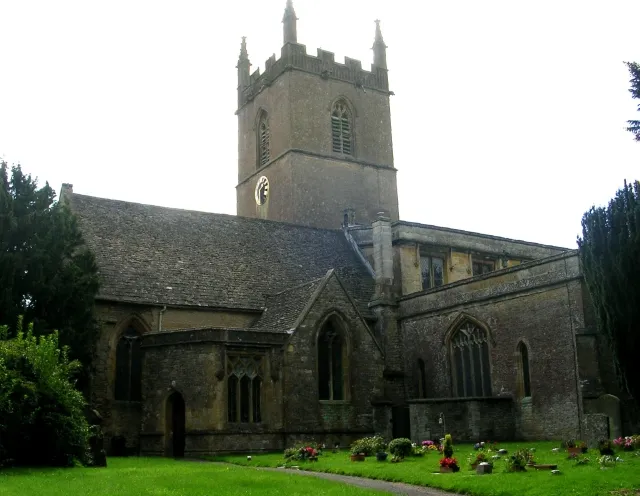
Photo: Betty Longbottom, CC BY-SA 2.0, via Wikimedia Commons
The photograph takes about four seconds. Two yew trees, one Norman doorway, a bit of careful framing — and then most visitors turn round, walk back down Church Street and order a flat white. Which is a shame, because the churchyard behind that doorway is one of the most quietly interesting half-hours in Stow, and almost nobody gives it the time.
Here's a slow circuit. It'll take you forty minutes if you read things, fifteen if you don't, and it pairs beautifully with a coffee on the square afterwards.
Start at the gate, not the door
Come in through the lychgate rather than the road entrance. It's a proper one, with a pitched roof and benches either side, and it was built for exactly the purpose you're about to use it for: a pause, a change of pace, a moment between the street and the stones.
The wall you walk along is worth a look in its own right. Cotswold drystone, patched in at least four different centuries by the look of it, with the coping stones set at slightly different angles because different hands did different stretches. There's a section near the north corner where the stone changes colour quite sharply — a repair, and a good one, but a repair all the same.
The yews, and the story everyone tells
Yes, the two yews flanking the south doorway are almost certainly older than the doorway they frame. Yes, the story that they inspired a certain well-known fantasy doorway has been repeated so often that the parish has long since stopped arguing about it. There's no documentary evidence, and the volunteers in the porch will tell you so, cheerfully, before telling you the story anyway.
What is true is stranger and better: yews were planted in churchyards for practical reasons — evergreen, long-lived, and poisonous enough to keep livestock off the graves. The pair here have been clipped and re-clipped so many times that their shape is as much a piece of local maintenance history as the wall behind them.
Reading the stones
Walk the south side first, where the older headstones cluster. This is where the churchyard rewards patience.
Look at the lettering. The eighteenth-century stones carry a script that a modern stonemason would struggle to reproduce without a template — deep-cut, confident, with the descenders of the 'g's and 'y's curling like they were drawn rather than chiselled. By the mid-nineteenth century the lettering goes stiff and upright, and the stones start being ordered from catalogues. You can watch the craft leave the churchyard in a single row of graves.
Look at the trades. There are stonemasons here, which always feels like a slightly unfair joke given the surroundings, but also shepherds, innkeepers and a run of what look like agricultural labourers. A handful of stones note ages in the sixties and seventies that read as long lives for the period; a much larger number note children, sometimes three or four on one stone, which is the part that stops you in your tracks if you let it.
And look at the repairs. Almost nothing here is original to the day it was erected. Bases have been re-set, inscriptions re-cut, leaning stones propped. A churchyard is not a museum of the dead; it's a maintenance job that has been quietly carried on for three hundred years.
The Civil War layer
In March 1646 the last major battle of the first Civil War was fought within sight of this tower, and the aftermath landed on the town. Prisoners were held in the church itself — hundreds of them, in terrible conditions — and if you go inside afterwards, the sheer scale of the nave puts that in perspective in a way no information board quite manages.
In the churchyard, the traces are quieter. Look for the memorials and plaques that record the dead of that period, and for the wear patterns on the paths where generations of feet have taken the same shortcut. There's a local tradition that certain stones mark the graves of men who died of their wounds after the surrender, though the records are thin enough that the volunteers will hedge — as they should. Ask them. They enjoy being asked.
The etiquette bit
A working churchyard has rules, mostly unwritten:
- Stick to the paths where you can. The turf over old graves is shallow and settles.
- Don't rub or chalk a stone to read it. If you can't read it in flat light, come back when the sun's lower.
- Children on the walls are fine. Children on the chest tombs are not.
- If a funeral or a working party is in progress, come back another day. This happens more often than you'd think and it's the one thing that genuinely upsets people.
- Dogs on leads, and pick up. Even the churchyard's most devoted visitors will judge you.
The circuit, and the coffee
Gate, wall, south-side stones, the yews, round the east end where the light is best in the morning, back along the north path, and out through the lychgate. Forty minutes, no steps that matter, benches in two places if you need them.
Then down Church Street — which is a lovely way to descend into Stow, with the tower behind you and the square opening up ahead — and into a coffee. Sit outside if the weather allows, and look back up at the tower you've just walked round. You'll see it differently. That's the whole point.